

Lahore’s smog crisis deepens as authorities fail to act
WORDS BY USWA SHAMAIL
EDITED BY IMAN SULTAN
PHOTOGRAPHY BY MAHIN AZAM KHAN
Every morning, my son and I take a trip to the street outside our home. As soon as he wakes up, he starts to chant “baahir baahir” (outside in Urdu) and claps his hands on the wooden door leading to the street. As he gazes intently at a flock of birds in flight, I watch him point a little finger toward an airplane cutting through the sky, and then I smile as he chases the neighborhood cats. But my favorite part is when the soft morning sunshine falls on his long eyelashes, casting stripe-like shadows across his cheek. Yet, with the advent of the smog season, the wooden door now remains firmly shut. I’m unsure how to explain to my fifteen-month-old why I can’t continue our beautiful routine anymore—why the air outside has become a danger to him.
In Lahore, my hometown, smog rears its ugly head every year with the onset of winter, and has become as mundane as the changing of the seasons. When it is at its peak, the air smells like an overcooked concoction of soot and burnt smoke. On most nights, with roads shrouded by a gray haze, smog reduces visibility to near zero, impacting the movement of vehicles, and increasing the risk of car accidents. Walking outside feels like suffocation, an ocular and respiratory cage, both literally and figuratively. Every morning, I dread looking at the Air Quality Index (AQI), praying and hoping that the smog has dissipated. Today, the AQI reads 177. Despite this number being categorized as “unhealthy,” I am relieved. Recently, Lahore ranked among the most polluted cities in the world, with AQI levels skyrocketing to 1900. Anything above 300 qualifies as “hazardous”.
For children like my son, smog is especially cruel. Their lungs are still developing, making them more vulnerable to respiratory diseases that if exposed, could persist for life. Already, two of my nieces suffer from smog-induced asthma. They wake up coughing and wheezing in the middle of the night, their tiny faces hidden behind the green-tinged plastic mask of the nebulizer as they sleepily rub their eyes. Many children lack access to nebulizers or medical treatment for smog-driven asthma and respiratory issues, contributing to a staggering 12 percent of deaths in under five-year-olds in Pakistan due to air pollution, according to UNICEF.
After learning this grim fact, I have limited my son’s outdoor activities, switching to birdwatching and sun-basking from the large portrait window in our living room, where the gold minaret of the neighborhood mosque and the outline of surrounding houses flicker in the haze. Still, he knows it is not the same. He tugs at my sleeve, nudging me to take him outside. He is too young to understand why I won’t take him outside and he slumps against the window in disappointment.

My personal experience with smog is only a sliver of its wider devastation in Lahore. Children from lower-income backgrounds are disproportionately affected with limited access to even basic safeguards like air purifiers or masks. Many live in poorly ventilated homes along Ferozepur Road, Walton Road, and Ravi Road—high traffic areas choked with toxic air, making exposure unavoidable. Schools face emergency closures for weeks on end, causing an already debilitated education system to crumble further. Hospitals are overwhelmed with patients suffering from smog-related respiratory issues, ocular diseases, and aggravated heart conditions. Lahore’s informal laborers—brick kiln workers, rickshaw drivers, and street vendors—cannot afford to stay indoors and are forced to breathe in the polluted air. Smog is not just an environmental or health issue; it is unraveling life as we know it.
Despite its unmistakable impact, those in power who can help address the smog crisis engage in denial. When asked about the largest contributors to smog, Ahmad (name has been changed), a top official at the Punjab Environmental Protection Department, described meteorological factors like the inversion effect and wind as “beyond our control.” He identified the transport sector as the largest polluter, contributing to a staggering 85 percent of Lahore’s smog, yet enforcement mechanisms remain woefully inadequate. According to Ahmad, emissions from vehicles are often assessed using the outdated “Ringelmann Smoke Chart,” which relies on visual judgment of smoke color rather than modern scientific methods. He acknowledged the lack of resources and infrastructure, noting, “We do not have the equipment or the HR [human resources] to enforce compliance.”
Efforts to hold polluters accountable have been hampered by weak regulations and self-reporting mechanisms. Industrial emissions, for instance, are poorly monitored. Ahmad said, “If the Water and Power Development Authority (WAPDA) isn’t monitoring its own emissions, how can we expect the private sector to comply?” The National Environmental Quality Standards (NEQS), which regulate emissions, remain under-enforced due to an ineffective monitoring system and lack of enforcement capacity.
International frameworks, such as the Paris Agreement, have also failed to translate into concrete reductions in emissions, stricter air quality regulations, or government-led mitigation efforts to curb pollution and smog. Pakistan ratified the agreement in 2017, but Ahmad pointed out that global initiatives often emphasize climate change over localized issues like smog. He said, “Smog is a local problem, not an international one.” This disconnect has left Lahore with inadequate support to combat its unique environmental challenges.
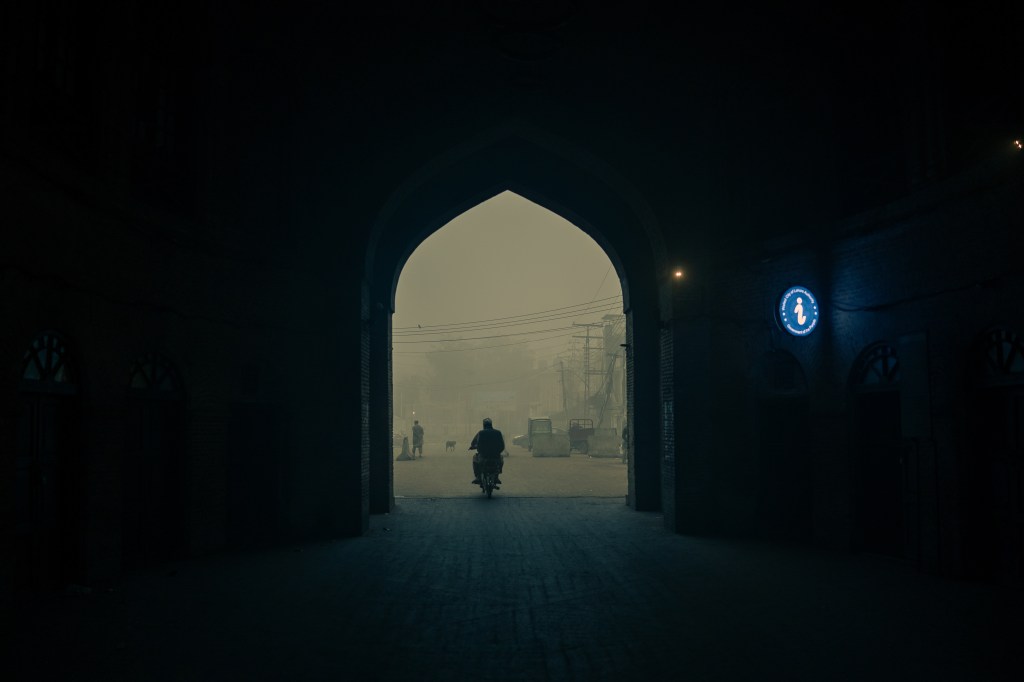
A friend working in the development sector alleged that in a meeting with senior environmental policymakers, the officials dismissed smog as a conspiracy by local political rivals, and blamed the emissions drifting across the border from India. This failure to recognize smog means denying a daily reality for those who live in Lahore: The thick, black clouds swirling out of diesel generators during the city’s power outages, the toxic smoke emanating from crop burning in the agricultural outskirts, and the undeterred industrial emissions mixed with vehicular exhaust fumes from burgeoning traffic. In the last five years alone, vehicles in the city have doubled to an astounding twenty million. Adding to this, the lack of a circular waste management system means agricultural and municipal waste is often incinerated, releasing harmful particulates, including PM2.5 and PM10, into the atmosphere. Scapegoating India for the smog crisis allows the government to evade responsibility while ignoring the local drivers.
In Pakistan, this neglect has already proven catastrophic. The 2022 floods, which submerged a third of the country and displaced millions, laid bare the government’s failure to prepare for climate disasters, much like its refusal to address the toxic air suffocating its cities. This failure is not unique to Pakistan. Around the world, right-wing governments have downplayed or outright denied climate change, prioritizing capitalist profit over environmental responsibility. Whether it is the United States’ withdrawal from international climate commitments or Brazil’s deforestation of the Amazon, governments and corporations have repeatedly sacrificed the planet for economic gain.
When it comes to solving the smog problem in South Asia, only a collective approach can lead to cleaner air on both sides of the border. In New Delhi, just a few hundred kilometers away, a court-ordered smog control plan introduced measures like vehicle rationing, strict industrial regulations, and investment in public transport. A study conducted by experts on EGU found that while the number of vehicles almost doubled in Delhi, the implementation of cleaner technologies and stricter industrial regulation reduced particulate matter by an estimated 29 percent between 2011 and 2021.
Though imperfect, New Delhi’s example shows what happens when the government takes action, rather than denying the problem exists. Lahore needs urgent action to curb the smog choking our lungs. It’s not that solutions are impossible: The government could introduce subsidies for farmers, and enforce an agricultural waste management system, as the burning of crop waste aggravates the toxicity of the climate. A circular waste management where waste and byproducts are productively reintegrated into crop production, would be far more effective than the current linear system that simply dumps pollution everywhere.

More importantly, the fight against smog requires a cultural shift. We buy air purifiers, wear masks, and stay indoors, but these measures adapt to the crisis instead of solving it. Breathing poison has been normalized. I am guilty of this, too. As I write this, my son naps next to me, and an air purifier hums in the corner of the room. Yet all I am doing is creating an illusion of safety inside my home.
For the sake of the children this bubble of inaction must burst, allowing them to breathe freely and see an unobscured blue sky. Resolving the smog crisis demands urgent intervention and moreover, it requires a shift in collective mindset.
Uswa Shamail is a Fulbright scholar pursuing an MS in Environmental Policy with a focus on social equity. Balancing her passion for community-building and global governance, she leads the Pakistani Students Association and interns at Pakistan’s Mission to the UN.
 backmattermag.org