
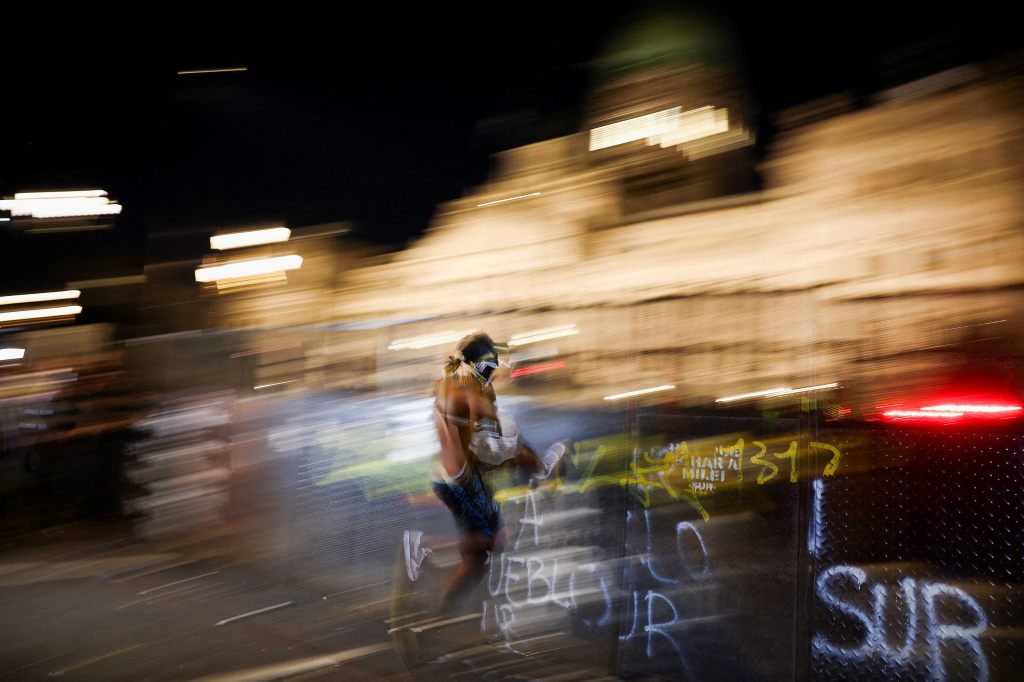
Examining the intersection of global conservative movements and Argentina’s struggle for education and democracy amidst Milei’s austerity measures
WORDS BY ELENA SALA
EDITED BY VISMITHA MANJUNATH YAJI
PHOTOGRAPHY BY AGUSTIN MARCARIAN
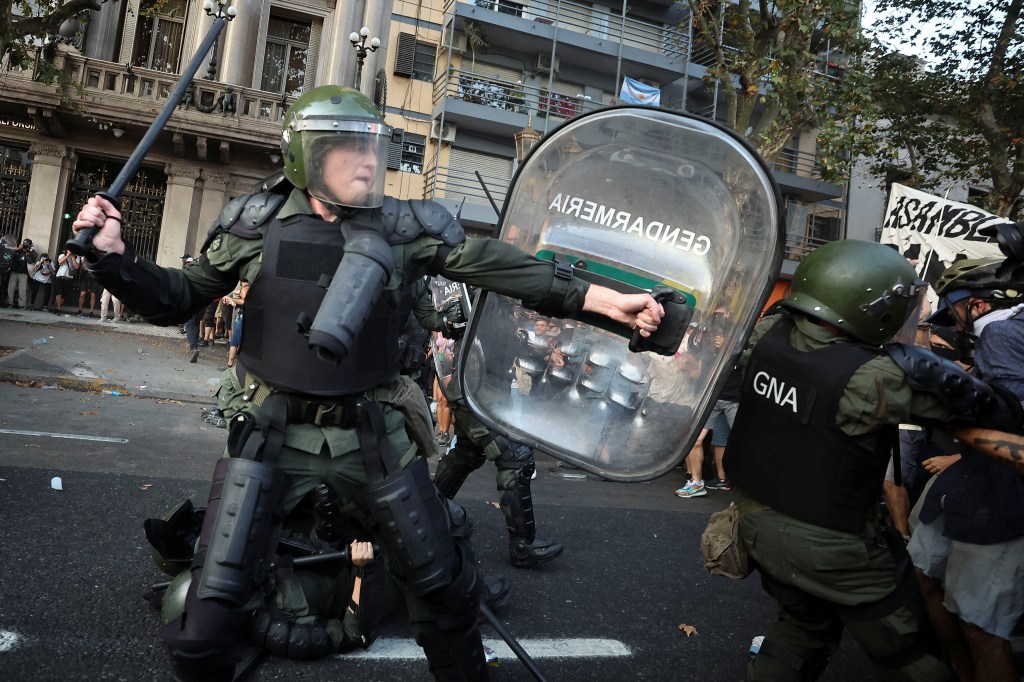
In October 2024, Argentina experienced a new wave of massive student uprisings against President Javier Milei’s neoliberal policies that threatened to cut the budget established for public universities. Due to inflation, the budget had already eroded, leaving the institutions to work with the bare minimum. Inflation in Argentina, which reached a year-over-year increase of 209 percent by September of 2024, led students at more than forty public universities to coordinate protests, demanding that President Milei adjust the budget to reflect the sharp increase in prices.
In the streets, thousands of students, teachers, and allies chanted: “Look how scared they are / Look how scared they are / To see students and workers again reunited / Like in the times of Cordoba.” They invoked the spirit of the 1969 Cordobazo, a movement that brought students and factory workers together in a historic revolt that led to Juan Carlos Onganía’s destitution—one of the first Cold War era Latin American dictators who the United States supported. Onganía received education about the National Security Doctrine at the United States West Point Military Academy. The National Security Doctrine perpetuates the theory of the “internal enemy” that military governments utilize to dismantle democracy. The doctrine laid the foundation for dictatorships throughout Latin America from the ’60s through the early ’80s.
Today’s political landscape presents stark differences. The recent student protests were initially nonpartisan, galvanizing support from people all over the political spectrum. For a brief moment, it seemed possible that they might spark systemic change in a way the political establishment could not. Yet, the 1960s are long gone. While the Cordobazo successfully pressured the existing institutions into change, Argentina’s Minister of Economy dismissed the historical demonstrations as a mere “tantrum.” Meanwhile, President Milei is consolidating his authority in ways that reduce democratic checks. Once known for its powerful grassroots movements, Argentina is now a testing ground for far-right leaders worldwide.
Milei’s threats to the autonomy and funding of institutions like the School of Law at the University of Buenos Aires (UBA), which ranked twenty-sixth globally by Quacquarelli Symonds (QS) in 2024, compelled even older generations, including my parents, to take action. They recognized that these laws threatened public, democratic, and accessible education. This broadening of opposition beyond student groups signaled a turning point. At a recent political rally, my father, who hadn’t attended an event in over a decade, and my mother, attending for the first time, joined me and fellow activists. This collective action was a powerful expression of our commitment to defending Argentina’s democratic identity.
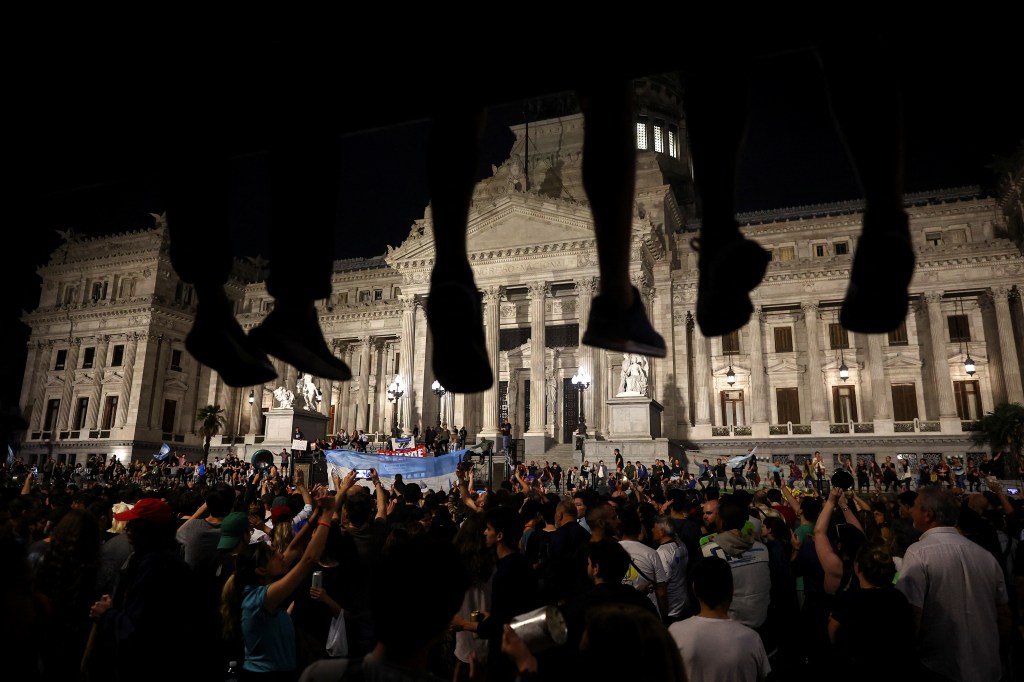
In the late 1960s, the Cordobazo left a lasting imprint on Argentina, reinforcing the power of public mobilization and positioning universities as symbols of social mobility. In 2024, however, President Milei vetoed a bill designed to secure public university financing. President Milei’s reforms led to student protests culminating in the largest university occupation in Argentine history. Unlike in 1969, today’s institutions are too weakened to counter the executive branch, and Milei’s government has responded with hostility. If institutions fail to stand up for democracy, what will it take for the people to reclaim their power?
Milei’s approach is part of a larger, transnational right-wing movement across the Americas, extending to the United States, where President Donald Trump is serving his second term. This ideological shift suggests a coordinated strategy rather than isolated instances of far-right threats to democracy. Both leaders seem to capitalize on public dissatisfaction to justify an authoritarian grip on power. Milei’s government doesn’t just critique the system; it aims to “implode it from within,” dismantling democratic norms in favor of centralized control. His use of executive decrees underscores this commitment. In just fifteen months of presidency, Milei has already signed fifty-six executive decrees, some of them of dubious constitutionality, as they touch on subject matters like criminal and tax law, and international indebtment, matters that are explicitly reserved to the Congress. The most recent example is as of last March 11, which was a controversial new debt agreement with the International Monetary Fund (IMF).
If traditional political avenues are being systematically blocked and public mobilization fails to influence policy, what alternatives remain?
Milei joins a cohort of conservative leaders worldwide who use veto power and executive orders as tools to bypass legislative processes. He dismisses opponents as “mandrills” and labels Argentine universities as filled with “leftist criminals,” using class content criticism to justify budget cuts to globally renowned public institutions. To Milei, all politicians are “burglars” except him. Congress is a “rat’s nest,” and scientists, teachers, and intellectuals are a part of the “impoverishing caste” who “believe that having an academic degree makes them superior beings.”
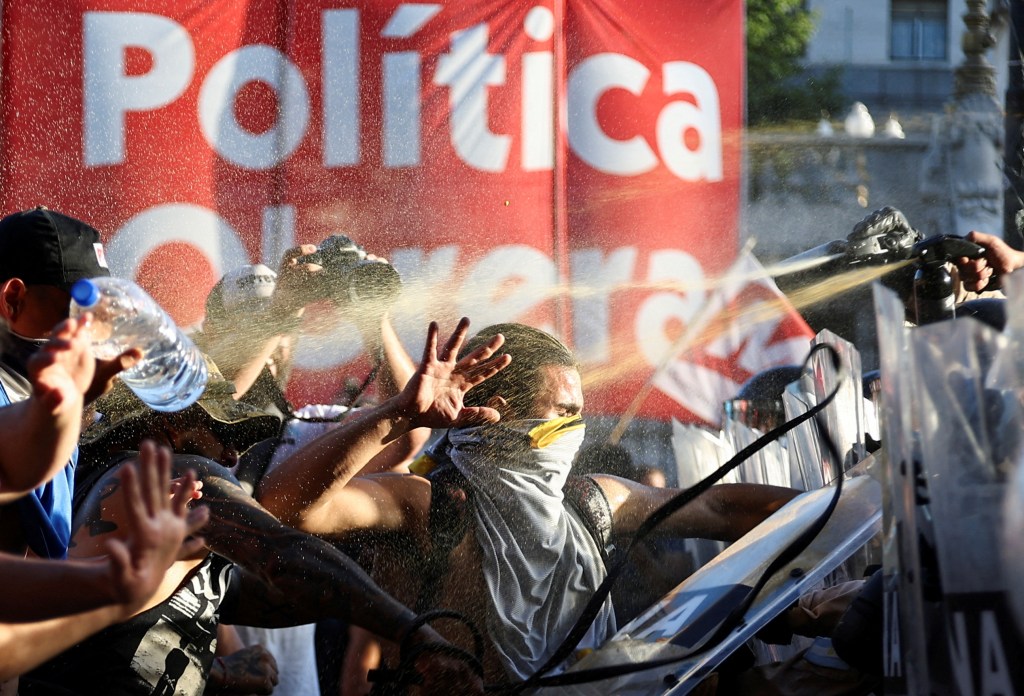
Both Presidents Milei and Trump use inflammatory remarks to cancel any form of critique by dehumanizing dissidents or those affected by their austerity policies. This cultural tactic unites the conservative movements in Argentina and the United States. Living in the U.S., I feel déjà-vu every time I listen to Trump (or his alter ego, Elon Musk), using the same rhetoric that has dominated Argentina since Milei took office in December 2023. These echoes between the two leaders underscore a shared agenda rather than mere coincidence.
Attacks on federal workers, unions, gay and transgender people, liberal scholars, pop culture artists (exclusively female), and Islam, alongside rampant and unconditional support for the Zionist government in Israel, have become the unquestioned fabric of political discourse today. The boundaries of presidential investment etiquette are being stretched so rapidly and extensively that expecting a distinction between public duty and personal gain feels like a naïve delusion, blurring the lines of accountability and ethical governance to the point of irrelevance.
On November 21, 2024, researchers from the faculty of Natural Sciences and Museum at the National University of La Plata (UNLP) and Conicet, both institutions outspoken in their protest against President Milei’s budget cuts, reported in Página 12 that they experienced “threats, insults, and harassment” while conducting geology fieldwork in the province of Mendoza. The harassers identified as members of the governmental party La Libertad Avanza (“Freedom Moves Forward”). They justified their aggression by claiming that the researchers from the public university were robbers: “They steal from the state, from us.” In their excusatory video they also took a moment to deliver a congratulatory message to Trump for winning the elections.” Milei’s followers identify themselves as the “praetorian guard of the president,” and this episode is not isolated but part of a bigger shift towards a use of language of open violence against dissidents. Just a few days before the incident, a group of Milei’s followers had launched Las Fuerzas del Cielo, “The Forces of Heaven,” an associated organization to the government that, as they claimed in the opening speech, aims to be “the armed wing of La Libertad Avanza,” amidst references to the conservative slogan “God, homeland, and family.”
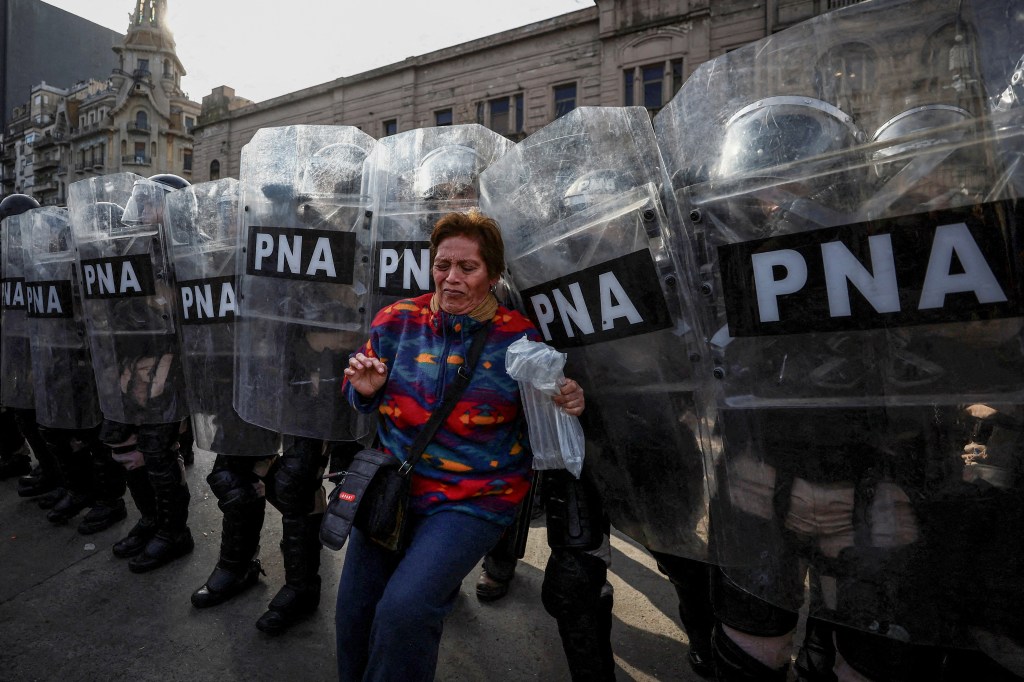
At the Davos Economic Forum in January 2024, Milei boasted about implementing “the biggest adjustment in human history,” celebrating an economic reform that slashed funding for universities, healthcare, and social services. During Milei’s first six months in office, according to the National Institute of Statistics and Censuses (INDEC), poverty in Argentina soared over 11 percent, pushing five million people below the poverty line, including three million into extreme poverty, unable to afford basic food. This represents the steepest poverty increase in two decades. Milei’s policies include a currency devaluation exceeding 50 percent, the near-complete removal of price and energy tariff controls, and the deregulation of healthcare providers.
Meanwhile, Trump and his allies in the United States, including Elon Musk, promise similar cuts, backing a two trillion dollar reduction in federal spending. While experts in a BBC report agree that such cuts are unlikely without devastating social impacts, both Milei and Trump carry on a global conservative agenda that aims not only at fiscal austerity, but to an overall reduction of government involvement in citizens’ lives—including the rollover of acquired rights such as healthcare systems, pensions, identity recognition, and education.
The Americas are facing intense political volatility; no president seems able to counteract systemic opposition to curb inequality, fueling frustration with the democratic processes. As the United States loses its global power, its institutions are increasingly viewed by its citizens as ineffective, mirroring Latin America (Argentina in particular), where institutions have long been seen as corrupt and unresponsive to public needs. Scholar Juan José Tokatlian observes that this rise in radical, right-wing options “responds to the failure of progressive politics to create a viable model for democracy and economic equality.”
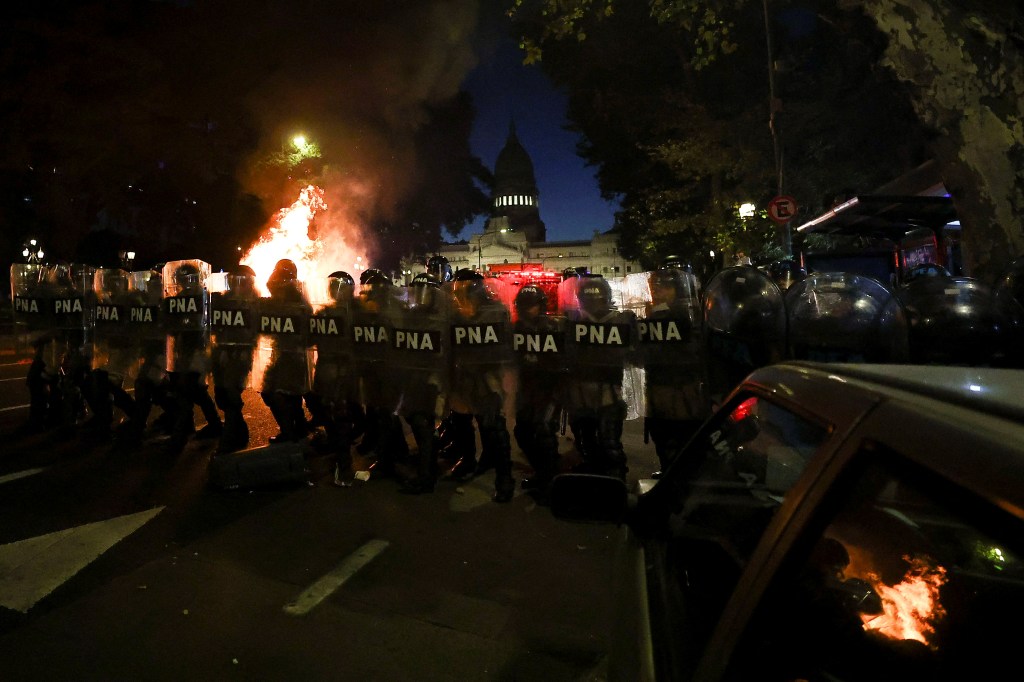
This perception of institutional failure fuels support for leaders like Milei and Trump, whose authoritarian stances promise order but deepen inequalities. Their appeal lies in their anti-globalist agenda, which criticizes traditional elites while emphasizing strong, centralized leadership as the answer to national crises. Once symbols of democracy, institutions are now wielded to entrench control, further alienating the public from systemic change.
Argentinean uprisings like the Cordobazo set a precedent for change through grassroots mobilization. Today, however, the new right’s consolidation of power leaves popular movements at an impasse. In this climate, resistance must evolve beyond traditional protests. If traditional political avenues are systematically blocked and public mobilization fails to influence policy, what alternatives remain? How much longer before the window for action closes entirely?
The challenge for grassroots movements is to reimagine opposition and develop strategies that bypass institutional obstacles. Whether revolution presents itself in transnational alliances, new platforms for dissent, or entirely novel structures, today’s opposition will need to adapt to counter the far right’s grip on power. Only by doing so can they hope to preserve the spirit of popular resistance in an era increasingly defined by authoritarianism and the “transnationalization” of this increasingly global right.
 backmattermag.org